|
Hello and welcome to Mind the Gap, a newsletter that adds perspective to the gender developments of the week.
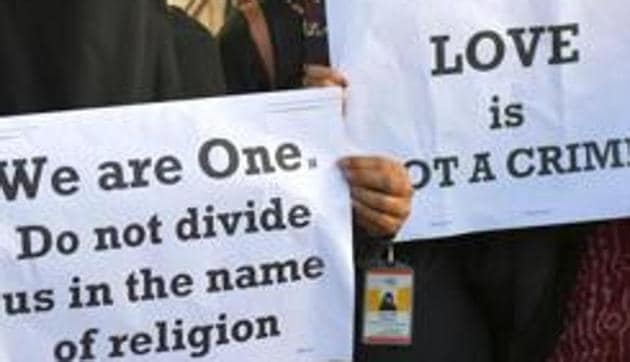
THE BIG STORY: FAQs on love jihad
As the interfaith couple--Muslim man, Hindu woman--was about to enter the registrar’s office at Moradabad, Uttar Pradesh (UP) on April 18 to marry under the Special Marriage Act, they were accosted by a group of Hindu Yuva Vahini activists. This is ‘love jihad’ the group alleged. The man had befriended the woman on social media, using a fake Hindu name, it claimed.
The police was called in to file a first information report (FIR) with various charges slapped on the man, including kidnapping and abduction. Then, they informed the woman’s parents who live in Ludhiana to come and take away their daughter.
Miles away in Kerala, a day later, the high court declined to intervene in an interfaith marriage between a Christian woman and a Muslim man. The marriage has been causing quite a ruckus since the man is a member of the CPI (M) and a Christian MLA from his own party raised questions about ‘love jihad’.
The woman’s father had filed a writ of habeas corpus (literally, ‘produce the body’) claiming that his daughter was being brainwashed but when she showed up in court, the 26-year-old pointed out that she had the right under the law to marry the man of her choice. The court agreed with her.
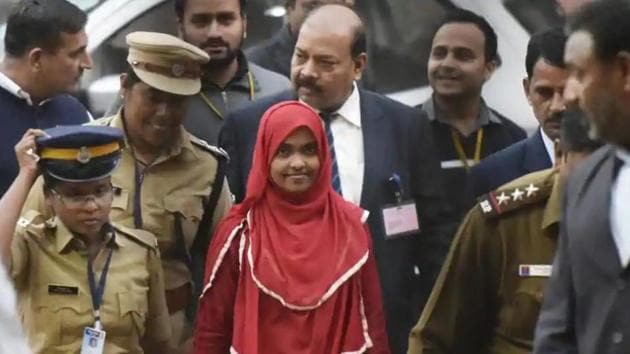
Memories of Hadiya
It was a very different court that had in 2017 pronounced judgment on a 24-year-old homeopathy student who had converted from Hinduism to Islam after which she married a Muslim man. Convinced that her conversion was under duress and fearing that his daughter was about to be sent off to join a terrorist organisation (she later told the court that she didn’t even have a passport), her father filed a habeas corpus petition in the Kerala High Court.
Calling Hadiya ‘weak and vulnerable’, the court declared her marriage null and void, and observed: “As per Indian tradition, the custody of an unmarried daughter is with the parents, until she is properly married.”
A year later, the Supreme Court overturned that judgment and agreed that Hadiya had the right and freedom to marry and live with a man of her choice.
It was during the course of this hearing that the National Investigating Agency (NIA), the country’s premier investigating agency was asked by the Supreme Court to examine interfaith marriages in Kerala. The NIA told the court it had found no evidence of coercion.
Interfaith marriages
Less than 1% of all Indian marriages, found Pew Research in 2021 are with spouses who were raised on a different religion, but may have since converted. Indeed across all faiths, a majority of Indians believe it is ‘very important’ to stop men and women in their community from marrying outside their religion, found the study.
In a country where 93% of all marriages are arranged by parents in line with faith and caste endogamy, the mere thought of an interfaith union continues to be anathema. In October 2020, jewellery maker Tanishq had to, under public pressure, withdraw an ad that portrayed an interfaith union.
Given this data, ‘love’ marriages and in particular, interfaith ‘love marriages’ certainly seem to attract disproportionate attention.
Love jihad in a nutshell
A right-wing conspiracy theory that has its origins in Kerala, would have you believe that there is a vast conspiracy under which Muslim men seek to entrap innocent Hindu (and sometimes Christian) women under the guise of love with the sole purpose of getting them to convert for the purposes of marriage.
Apart from the obvious paternalism of such a theory, denying adult women the agency or even believing them to be capable of making up their own mind, there’s the inconvenient fact about proof.
In January 2020, National Commission of Women (NCW) chairperson Rekha Sharma called Kerala a ‘ticking time bomb’ that would explode unless the state government acted. In October she met with Maharashtra governor Bhagat Singh Koshyari to discuss the ‘rise in love jihad cases’.
But there was no back-up for this sort of claim. Aniket Aga, a professor at Ashoka University, made an attempt to get details from the NCW under the Right to Information Act but was stymied (see more here).
That same month, the Syro-Malabar church complained to the National Commission for Minorities that 11 Christian women had been converted to Islam and taken to Syria. Once again, Kerala police, acting on the complaint, found no evidence of ‘love jihad’.
What is the love jihad law?
As of this time, 10 BJP-ruled states, starting with UP in November 2020, have laws to prevent unlawful religious conversions. These include Madhya Pradesh, Uttarakhand, Gujarat, Karnataka and, the latest to join, Haryana.
These laws have been enacted to prevent forceful conversion. But they also introduce administrative hurdles for interfaith couples who wish to marry. Within just one year of introducing the law in UP, 108 police complaints against 340 people had been filed. In this time, according to The Leaflet, there was not even one conviction.
Why the Special Marriage Act isn’t always the answer
Enacted in 1954, this law enables two individuals of different faiths to marry. Amongst its requirements is 30-day notice with details of the intending couple displayed in public so that anyone with objections can come forward.
But putting on display the personal details of the couple, including their address and phone number is also a red flag to vigilante groups opposed to the idea of an interfaith marriage.
In some states it is routine for police to call interfaith couples and their parents to the police station, Lucknow-based lawyer Renu Mishra of the Association for Advocacy and Legal Initiatives told me.
The law does not require consenting adults to seek parental approval. But in a country where ‘honour killings’ continue--there is no separate data maintained by the National Crime Records Bureau for these crimes--couples don’t always have the luxury of waiting for 30 days. Religious marriages, on the other hand, require no such notice. So, it just becomes expedient for one of them to convert.
The anti-‘love jihad’ laws as well as the provision that requires 30-day notice are both under legal challenge in the Supreme Court.
|